

Reimagining Customer Service with AI: From Business Ambition to Technology Reality
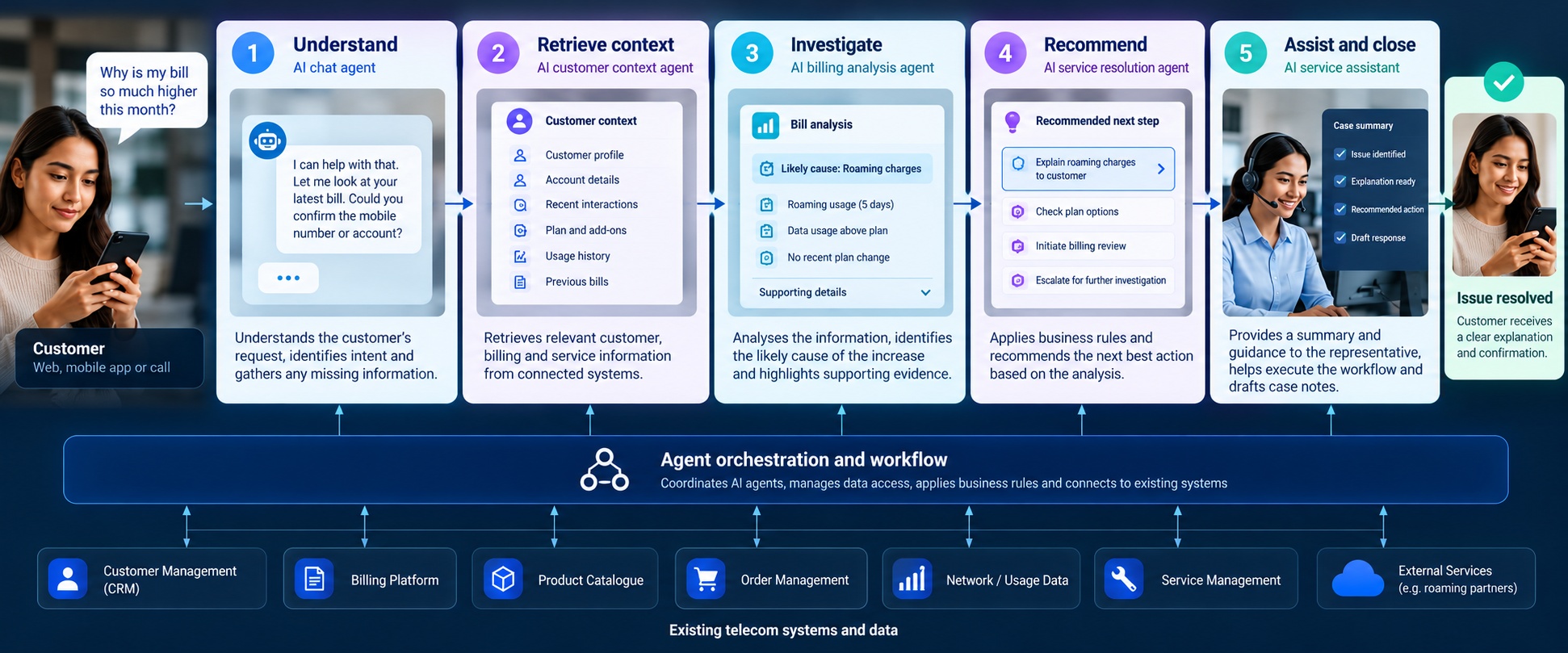
From intelligent conversations to connected customer experiences.
Telecommunications providers are exploring how AI agents can transform customer service – from answering routine questions to investigating complex issues, recommending actions and helping execute service workflows.
But delivering these experiences requires more than deploying a conversational chatbot. A customer query may involve understanding natural language, retrieving information from multiple systems, interpreting billing data, applying business rules and initiating an approved action. Different AI agents and supporting technology capabilities need to work together to make this possible.
For a Chief Digital Officer or Head of Digital Transformation, the opportunity is to create a more seamless customer journey across digital self-service and assisted service channels.
For a Head of Customer Service or Contact Centre Director, the priority is to help service representatives resolve issues faster, reduce manual investigation and provide customers with clear, accurate answers.
For a CTO, CIO or Enterprise Architect, the challenge is to connect AI agents securely to the data, applications and business workflows they need, while maintaining architectural integrity and operational control.
These priorities are different, but they converge on one important question: how can AI improve customer experience within the reality of an existing telecommunications technology landscape?
The use case: A customer queries an unexpectedly high bill
A customer receives a bill that is significantly higher than expected. They open the provider’s digital service channel and ask:
“Why is my bill so much higher this month? I haven’t changed how I use my phone.”
Answering this question requires more than generating a plausible response. The provider needs to establish what changed, retrieve the relevant evidence, explain the likely cause and determine what should happen next.
An agent-based AI workflow could address this through a coordinated set of capabilities.
How the AI-enabled workflow could work
The AI chat agent is the customer’s conversational entry point. It interprets the question, identifies the customer’s intent and gathers any missing information needed to investigate the issue.
It may recognize that the customer is asking for a bill explanation, confirm which bill they mean and communicate what will happen next.
· Digital Transformation Viewpoint: Provide a natural-language entry point to customer service and maintain a consistent conversational experience across supported digital channels.
· Customer Service Viewpoint: Handle routine information gathering before escalation to a human representative, allowing staff to focus on issues that require judgment or intervention.
· Technology Viewpoint: Ensure secure customer authentication, controlled access to relevant services and a defined interface through which the agent can request information or invoke other capabilities.
2. The Customer Context Agent: Retrieve the customer’s relevant history
Once the request is understood, an AI customer context agent gathers relevant information from connected systems. Depending on the provider’s architecture and permissions, this could include the current and previous bills, plan details, usage records, recent plan changes and earlier service interactions.
The agent consolidates the relevant information into a structured customer context and makes it available to the next stage of the workflow.
If the customer later moves from digital self-service to a human representative, that context can be passed along with the conversation. The customer does not have to start again simply because the channel has changed.
· Digital Transformation Viewpoint: Enable continuity between supported channels by transferring the conversation summary and relevant customer context to the next interaction.
· Customer Service Viewpoint: Provide the representative with a consolidated view of the customer’s issue and history, reducing manual searches and repeated questions.
· Technology Viewpoint: Establish integration with CRM, billing and service platforms, appropriate identity and access controls, and clear rules about which customer data can be retrieved.
Importantly, the context agent does not automatically know everything about the customer. Its usefulness depends on the quality, availability and permissions of the connected data.
3. The Bill Analysis Agent: Investigate the increase
With the relevant information assembled, an AI billing analysis agent examines the current bill against historical usage, plan allowances, applicable charges and relevant account events.
It might identify that the increase coincides with roaming usage, additional out-of-plan consumption or a recent change in the customer’s subscription.
The agent should distinguish confirmed facts from possible explanations. Where the evidence is incomplete, it should request additional information or escalate the investigation rather than present a guess as fact.
· Digital Transformation Viewpoint: Make the digital interaction more useful by moving beyond generic FAQs to explanations grounded in the customer’s actual circumstances.
· Customer Service Viewpoint: Assist representatives to understand the likely cause of the bill increase without manually comparing multiple records and systems.
· Technology Viewpoint: Access to reliable billing data, clearly defined analytical logic, traceable evidence and appropriate controls over how the agent reaches its conclusions.
For calculations or charge validation, the agent should use authoritative billing data and deterministic rules or services where appropriate, rather than relying on a language model to perform critical calculations unaided.
4. The Service Resolution Agent: Recommend the next action
Once the likely cause has been established, an AI service resolution agent combines the investigation findings with the provider’s approved service policies and business rules to recommend the next step.
For example, it might explain the roaming charges, provide a breakdown of additional usage, suggest an eligible plan review or initiate a billing dispute workflow if the evidence indicates that further investigation is required.
The agent can prepare the relevant information and request the appropriate workflow. Actions such as changing a plan, applying a credit or making an account adjustment should only proceed when the necessary eligibility checks, permissions and approvals are satisfied.
· Digital Transformation Viewpoint: Connect the explanation to a useful next step, so the customer journey can progress from understanding the problem to resolving it.
· Customer Service Viewpoint: Provide representatives with a recommended resolution and supporting evidence, while preserving human review for exceptions and higher-risk decisions.
· Technology Viewpoint: Enable controlled access to business services and workflow APIs, with validation, authorization and audit trails for actions that affect customer accounts.
5. The Service Assistant: Support the representative and complete the interaction
If the issue needs human involvement, an AI service assistant provides the representative with a concise case summary, the evidence behind the billing explanation, relevant policy guidance and the recommended next action.
The representative can review the information, ask follow-up questions and initiate an approved workflow. After the interaction, the assistant can draft the case notes and summarize the agreed resolution for the representative to verify.
· Digital Transformation Viewpoint: Ensure a connected experience when a customer moves from an automated interaction to assisted service, with relevant context carried forward.
· Customer Service Viewpoint: Reduce time spent searching for information and documenting interactions, helping representatives focus on the customer and the resolution.
· Technology Viewpoint: Enable the agent to operate within the contact-centre environment, use authorized information and respect the controls governing system access and record updates.
The result is not necessarily a fully autonomous service interaction. It is a workflow in which conversational AI, customer context retrieval, analytical reasoning and service execution work together, with human involvement where appropriate.
What needs to work behind the agents?
The scenario illustrates why deploying individual AI agents is only part of the challenge. Their value depends on the environment in which they operate.
- Trusted customer and billing data. The customer context agent and billing analysis agent need access to accurate, current and appropriately authorized information. Inconsistent records or missing usage data can undermine the quality of the outcome.
- Integration with existing applications. The agents need controlled access to CRM, billing, product catalogue and customer-service capabilities. APIs, connectors and other integration mechanisms make it possible to retrieve information and interact with these systems without replacing them wholesale.
- Agent orchestration. The workflow needs to determine which agent should act, what information it receives, what it can request from other agents and when the process should stop, ask for clarification or escalate to a person.
- Business rules and controlled execution. Explaining a charge is different from changing an account or issuing a credit. The architecture must distinguish information retrieval and recommendations from actions that require validation, authorization or human approval.
- Security, governance and observability. Authentication, least-privilege access, audit trails, monitoring and evaluation are essential to understand what the agents accessed, why they produced a recommendation and whether the workflow achieved its intended outcome.
- A path to measurable value. Providers need to evaluate whether the solution improves resolution time, first-contact resolution, repeat-contact rates, customer satisfaction and agent productivity. These measures help determine whether the capability should be refined or expanded.
Why composable IT matters
Telecommunications providers already operate complex technology landscapes supporting billing, customer management, order processing and service operations. Replacing these platforms simply to introduce AI is rarely a practical starting point.
Composable IT offers a way to evolve this environment through focused, interoperable capabilities. Rather than making every improvement dependent on a large transformation programme, providers can connect and extend existing systems to address specific business needs.
In this scenario, the AI chat agent provides the conversational interface, the customer context agent retrieves relevant information, the billing analysis agent investigates the issue, and the service resolution agent helps determine the next action. These agents rely on connected data and existing business services to make the overall workflow useful.
The architectural opportunity is to expose the right capabilities through governed interfaces, coordinate how they work together and introduce improvements incrementally. The same approach can support additional customer-service use cases as the provider’s requirements and AI capabilities mature.
Composable IT is not a substitute for good AI design, reliable data or appropriate governance. It provides an approach for connecting the technology capabilities on which AI-enabled workflows depend.
From AI agents to business outcomes
The real opportunity in telecommunications is not simply to introduce more chatbots or deploy more AI agents. It is to connect conversational understanding, customer context, analysis and controlled action into workflows that solve meaningful business problems.
For digital leaders, this can enable more coherent customer journeys. For technology leaders, it creates a practical challenge of secure integration, orchestration and governance. For customer service leaders, it offers a way to reduce manual effort and help customers reach a resolution more effectively.
Achieving these outcomes requires business processes, data, applications and AI agents to work together – not in isolation.
The path to more intelligent customer service is not just about building smarter agents. It is about connecting those agents to the systems, information and workflows that allow them to deliver real outcomes.